I ran my own heavy metal testing regimen in 2011 and was very concerned when my tests revealed very high lead levels.
I asked my Dad if the water pipes in our family home are lead-lined. They are, and I am convinced this was a constant source of lead exposure all the way through my childhood.
My test results are shown later in this article.
Lead is highly toxic and there’s no known function for it in your body.
When it enters the body, lead can accumulate in your brain, nervous system and bone (from where it can take a very long time to remove the lead burden).
Because of its sites of accumulation, lead as the potential to cause a whole host of symptoms.
Sources of lead
There are a number of routes by which lead can enter your body. Here are the most common ones:
- Passed from mother to fetus during pregnancy (in other words, a big dump of lead in your body before you’re even born!)
- Old homes (from paint and water from lead-lined pipes, the latter being where I think I picked-up my lead burden)
- Painted dishes and cookware
- Canned foods
- Some protein powder drinks
- Make up (in one study, 96% of cosmetic products tested contained lead – they also contained thallium, beryllium, cadmium and arsenic)
- Lead solder if you work with these instruments (my Dad did for 40 years and I wonder whether I picked up some lead from that, too!)
- Toys from countries such as China
- Children’s jewellery
- Certain processed foods
- Lead fallout on the ground after decades of lead-containing petrol
- Mining
- Industrial pollution
- Smelting plants
Lead emissions from industry pollute your food and water, and lead residues from old leaded petrol are present on the ground virtually everywhere. Thus, it’s easy to see how lead toxicity can develop over time.
When I look at my life logically, it’s easy to see why I managed to accumulate so much lead in my tissues.
Lead poisoning symptoms
According to Dr. Stephen Sinatra, MD, an acclaimed cardiologist of some thirty years, chronic lead toxicity is directly linked to an increased risk of:
- High blood pressure
- Heart disease
- Kidney disease
- Psychiatric symptoms.
Researchers at Harvard School of Public Health found that age was not predictive of high blood pressure once lead toxicity was included as a factor. In other words, it’s not your age that leads to high blood pressure – it’s your toxic burden. Advancing age simply reflects the length of time you’ve been exposed to lead (and other toxins).
Most lead entering your body ends up in bone. Again, Harvard researchers studying premenopausal women found that as bone lead levels increased, so too did blood pressure.
Another snippet of wisdom from Dr. Sinatra:
“Cadmium and mercury synergize with lead and cause all kinds of physiologic havoc not really addressed in mainstream medicine. We believe that much of the rise in blood pressure that we see with aging in Americans – the incredibly common disease state that we call essential hypertension – has a basis in accumulative heavy metal overload.”
In addition to its possible role in high blood pressure and heart disease, lead may cause the following symptoms:
General lead poisoning symptoms:
As I discuss in several sections on this website, a myriad of people are wandering round each day with symptoms related to the seven areas of health.
It can be tough to know precisely why these symptoms are happening because of the tremendous overlap of symptoms caused by such things as poor diet, food allergies, digestive infections (bad bugs), various toxins, nutrient deficiencies and hormone imbalances.
Lead toxicity can cause some of these common symptoms:
- Digestive symptoms, including stomach ache, abdominal cramping, constipation, “IBS” or diarrhoea
- Nausea and vomiting
- Unexplained fatigue
- Headaches
- Muscle weakness
- High rates of tooth decay
This is an excellent diagram I found at dmsachelation.com, illustrating the main symptoms of chronic lead poisoning:

Lead in children
Because children’s nervous systems are developing, like mercury, lead can be particularly dangerous to them. In addition to the above diagram, symptoms of lead toxicity in children include:
- Irritability or aggression
- Hyperactivity
- ADD and ADHD-type symptoms
- Other learning problems
- Lack of interest in being playful
- Loss of appetite
- Sleep problems
To make an important point: if your child has some of these symptoms, it may NOT be lead and could quite easily be something simpler such as gluten intolerance or a bad bug.
Testing your lead levels
Lead that accumulates in your body can’t be measured accurately because, well, it’s in your bones!
Thus, it’s impossible to determine with 100% accuracy how much lead has built up in your body, but you can certainly gain a good understanding using the Hompes Method Testing Toolkit.
There are four types of laboratory tests for the detection of lead and other toxic metals in your body:
- Blood
- Urine
- Hair
- Stool
There is also a second urine test, called a porphyrins test, which can tell you whether lead or other heavy metals are having a toxic effect on your body.
Apart from the blood test, all these laboratory tests can be performed in your own home, which makes them extremely convenient.
If you’d like further information on each specific test, please click on one each of the four links, above, or download my special report entitled What You Need to Know About Heavy Metal Testing.
Which tests do you need?
I’m often asked this question and, to be honest, in order to get a full understanding of your heavy metal levels, it’s ideal to run as many of the tests as you can.
You cannot get an accurate picture of your mercury levels without combining the tests, because each test profile provides information that must be interpreted in different contexts.
For example:
- The blood test tells you more about your recent or ongoing lead exposure.
- The hair test tells you about how much lead is being pushed out of your body in your hair over an approximate 2-3 month period.
- A urine test with supplements to actively pull lead out of your body begins to give you an idea about your total body load, or burden (which can’t be assessed any other way – this is one of the most important tests to perform to detect lead levels).
- The porphyrins test tells you whether lead is causing specific blocks in your metabolism.
However if budget is a concern, a less financially demanding testing regimen can be designed for you. I’ve found the following tests most useful:
- Urine test with supplements to release lead from its storage sites in your body (only under supervision)
- Hair
- Porphyrins
If you can run these together it’s a great starting point.
Please note that blood and hair tests also determine your nutrient element levels (e.g. zinc, calcium, potassium, selenium, magnesium, etc.), which are obviously very important.
In other words, a well-designed testing regimen looks at both toxic metals and “good” minerals at the same time, which gives you the biggest bang for your buck.
My heavy metal test results from 2011
I ran a series of tests in 2011 to check my toxicity levels.
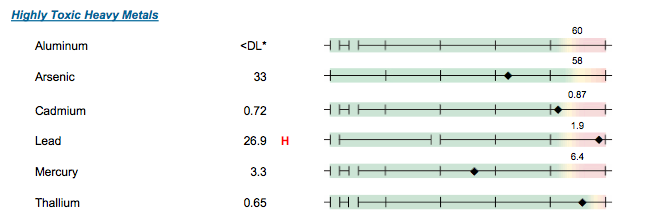
As you can see below, my urine test – sample taken following a standard challenge/provocation test to pull toxic metals out of storage sites in the body so they appear in the urine – showed an extremely high lead level.
After I investigated all the possible ways in which lead could have accumulated in my body, I realized I’d probably acquired lead from my Mum when she was pregnant, and from anything prepared with tap water, as the family home’s water pipes are lead-lined!
My blood test, below, also showed high lead, in addition to high aluminum. The aluminum was coming from an underarm deodorant product, the ingredient label of which I’d carelessly misread.
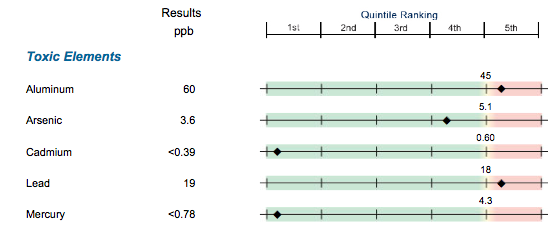
I’d like to point out that I felt pretty good in 2011 when I ran these tests, but on seeing the results I really started to wonder what “good health” actually is and how I’d feel without any of these potent toxins in my body, not to mention the risk of future disease.
Needless to say, I began (and am still working on) a thorough detoxification program and I know because lead accumulates in bone that it’s going to be a long and drawn-out process for me to reduce my body’s burden of this toxin!
I have to say that until I fine-tuned the detox program to my body’s requirements, I had a lot of side effects (mainly related to mood and energy) from moving so much lead out of its storage sites and into my circulation.
How important are heavy metal tests?
Whilst these tests are all important, the detoxification of lead and other toxic metals from your body is something that should only be addressed AFTER you’ve dealt with other important issues.
It’s very tough on your body to run specific detoxification programs without first getting your diet, digestive function, liver/kidney function and nutrient / hormone levels optimized.
Failure to work on these issues in the optimal sequence can result in extreme problems during the detoxification process.
I don’t recommend you enter into a serious “heavy metal” detox program without supervision.
That said, if you run testing to check your nutrient mineral levels using the hair and blood tests, you automatically get an idea of your toxic metal levels, up to a point.